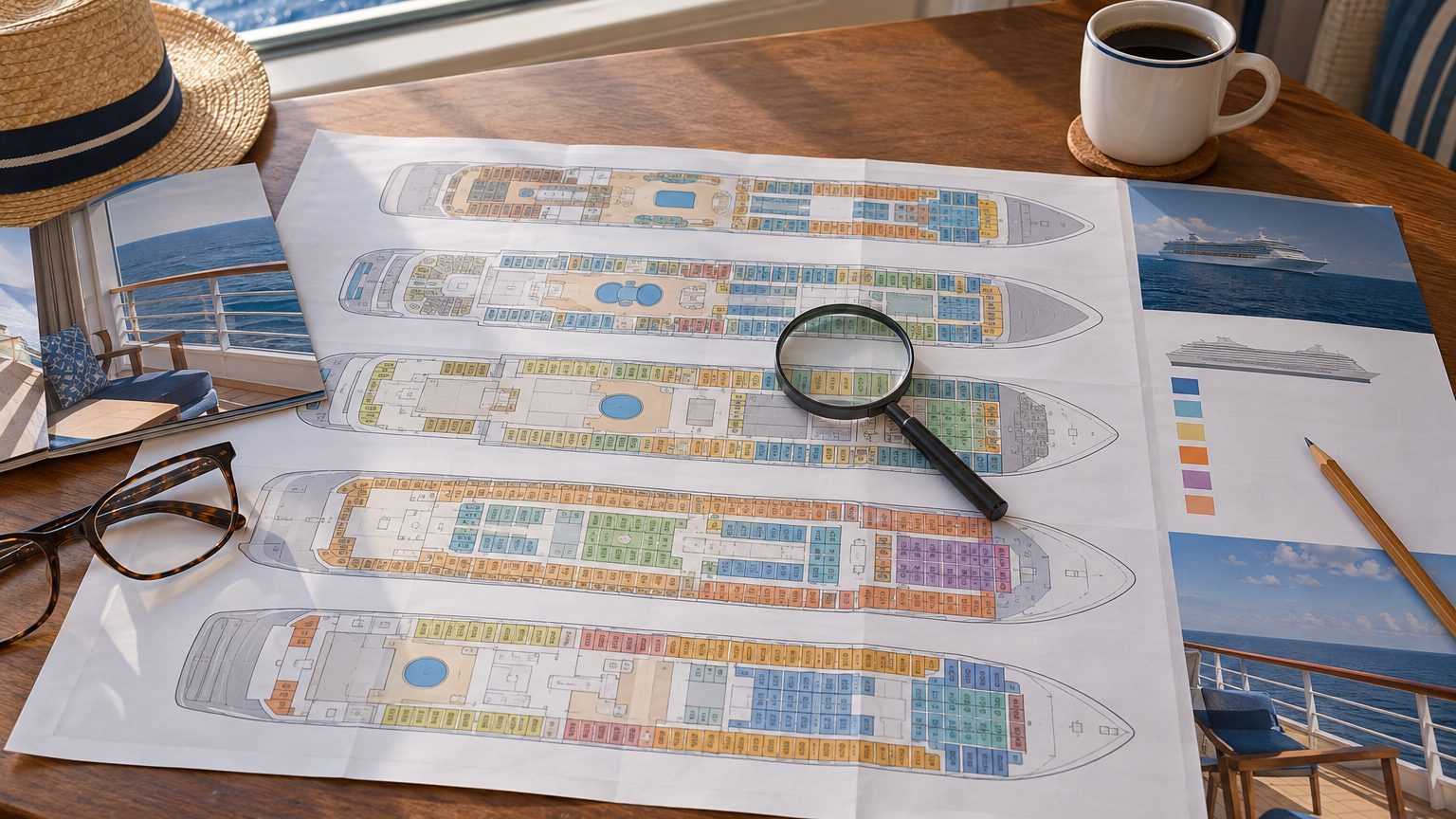
A cruise deck plan is a top-down floor map of one deck, repeated for every deck on the ship. It shows where each cabin, elevator, stairwell, venue and service area sits. Download the plan for your exact ship from the cruise line’s website or app, find your cabin by number, and read what is directly above, below and beside it. Then use the legend to decode the colors and icons. A cabin ringed by other cabins and quiet public rooms is usually the safe pick. One under a pool deck, next to a galley or behind a lifeboat is where noise and blocked views tend to come from.
What Do Cruise Deck Plans Actually Show You?
Decks are usually numbered from the bottom up, and the biggest ships run to 20 or more. The embarkation deck and the lowest cabin deck vary by ship, so check the plan for your own vessel. Each deck gets its own page or tab. You see the cabin grid with numbers, the corridors, the elevator and stair banks, and the restaurants, bars, theaters and pools. Crew-only zones are often shown as blank or shaded areas, and those blanks matter, because they sit next to or under cabins.
What the plan does not show is just as important. It is a drawing of layout, not of sound, motion or the actual view. Because it only shows layout, treat it as a screening tool that rules cabins out. Three gaps are common:
- Exact cabin size: the plan rarely labels cabin size. Square footage usually sits in the line’s category descriptions or in the pop-up for a specific cabin.
- Noise: the plan shows what is above and below, not how loud it gets. Cruiser reviews and photos fill that gap.
- The real view: the plan may flag an obstruction without saying how severe it is. Look for traveler photos of that exact cabin number.
How to Find Free Deck Plans for Your Cruise Ship
Start with the cruise line. Every major line publishes deck plans on its site, and most add a cabin finder in the app. Princess, for example, lets you pick the ship from a menu, type a cabin number to jump straight to that deck, and click a cabin to see its category, deck, bath type, whether it connects, and its total size. Royal Caribbean has distributed printable reference guides that pair each deck with a legend and a category list. Use the official version first, because it matches what the booking engine sells.
Third-party sites add things the lines do not. Some sites collect plans for many ships in one place. Another site offers printable plans plus a cabin check tool that shows what is above or below a stateroom. Cruiser forums add “cabins to avoid” threads for specific ships. Treat those as community experience, since one cruiser’s noisy cabin may be another’s quiet one.
Before you trust any plan, confirm it belongs to your ship and your sailing year. Check four things:
- The ship’s name matches your booking, not just its class.
- The plan carries a revision date, and that date is recent. A PDF labeled for 2018-2019 predates any later refit.
- The venues drawn on the plan match the venues on the ship’s current page, especially the pool deck and specialty restaurants.
- The cabin number from your booking appears on the plan. If it does not, you have the wrong version.
Where Are the Cabins Located on a Cruise Deck Plan?
Orientation comes first. Forward is the front of the ship and aft is the back, with midship in between. Port is the left side and starboard is the right side when you face forward. Plan orientation varies. When the bow points up the page, port is the left side of the drawing, but many plans are drawn sideways, so find the bow marker first. Port and starboard have nothing to do with which side faces the pier. Docking direction changes from port to port, so a “port side” balcony may face the dock one day and open water the next.
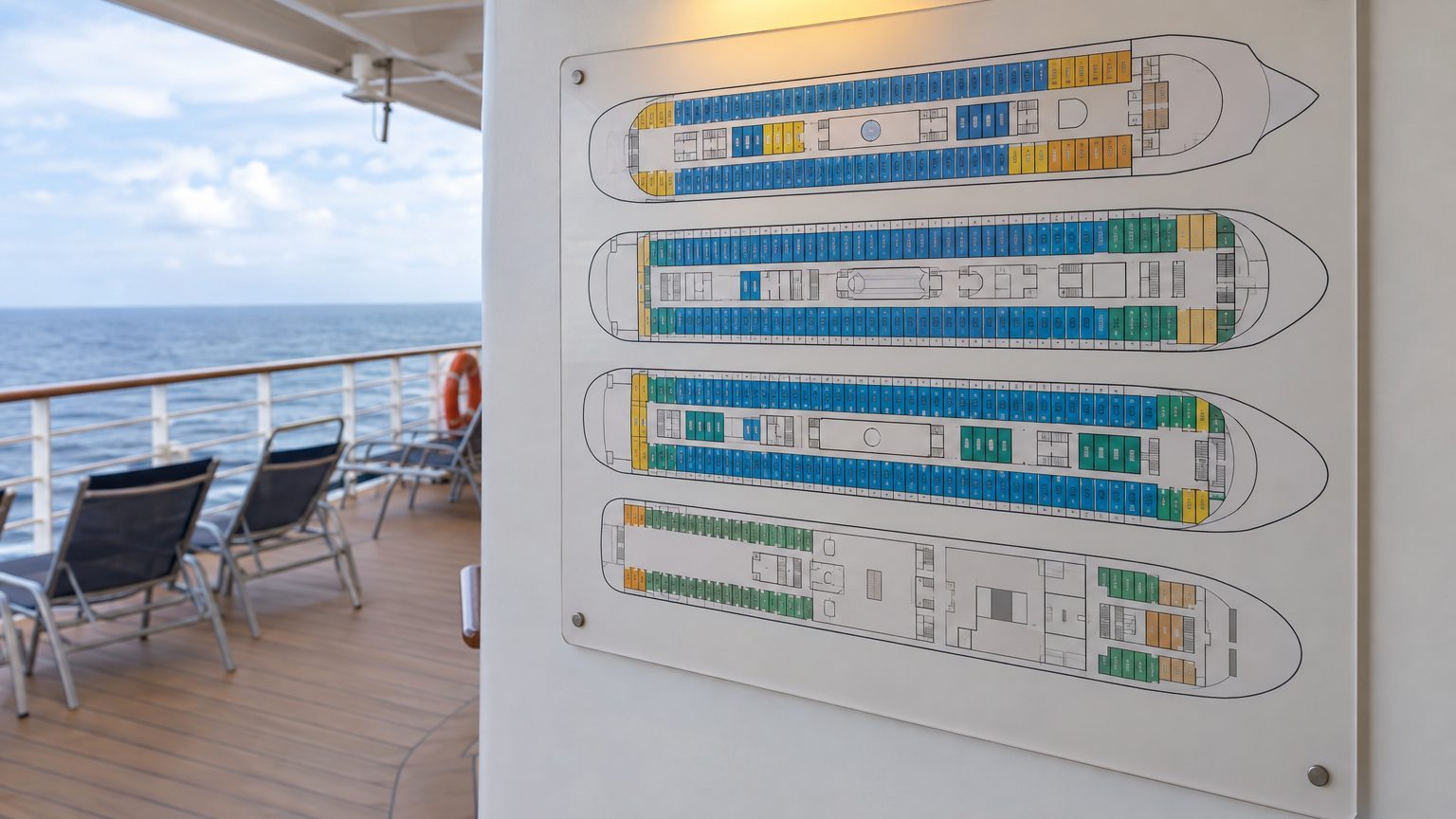
Odd and even numbers usually split the two sides, but lines disagree. Princess’s deck plan guide puts even numbers on the port side and odd numbers on the starboard side. Cruiser reports describe the same split on Holland America, while one forum thread found the reverse on a Celebrity plan. Older Norwegian Dawn and Jewel class ships are reported to split port from starboard by the hundreds digit instead. Read the numbers off your plan and ignore any rule of thumb.
The digits themselves follow a loose pattern. Here is a clearly generic example, not any specific ship: in cabin 8412, the 8 is the deck and 412 is the position along that deck. On decks numbered 10 or higher, the first two digits are the deck, so 10547 sits on Deck 10. Position numbers usually start at the bow and climb toward the stern, though some ships reverse that. Confirm on the plan by comparing the numbers at both ends of a corridor.
How to Use Deck Plans to Avoid Noisy or Obstructed Cabins
This is where a deck plan earns its keep. You are not trying to find the best cabin, only to remove the ones with a visible problem next door, upstairs or downstairs. Everything below describes common traveler-reported issues, not guaranteed outcomes.
The above, below and beside neighbor check
Run the same five steps on every candidate cabin.
- Find the cabin on its deck page and note the numbers on both sides and across the corridor.
- Open the deck directly above and find the same spot. Cabins and corridors are fine. A pool, lido buffet, bar, gym, basketball court or sports deck is a flag.
- Open the deck directly below. Cabins are fine. A theater, nightclub, galley, laundry or machinery space is a flag.
- Look beside the cabin: elevators, stairwells, service doors, crew corridors and storage rooms.
- Look outward. On balcony and oceanview cabins, check for lifeboats, tenders, overhanging decks or structure in front of the window.
Red flags on the plan and what to verify
Motion and engine noise follow location. The lower and more central a cabin is, the less roll and sway you feel, while higher decks and the front or back of the ship rock the most. Rooms low and at the back are closer to engine noise, which causes vibration, and rooms low at the front are closer to the bow thrusters and the anchor.
For view problems, an obstructed-view stateroom is an outside or balcony cabin where ship structure or lifeboats partly block the water view. Lines usually flag these cabins in their category descriptions or with a symbol on the deck plan. Severity varies. Cruisers describe cases where a lifeboat only blocks the downward view from a balcony, and others where the top third of a window is blocked. Some travelers also report aft balconies on lower decks of Royal Caribbean’s Freedom and Voyager classes with metal structure that is not always flagged as obstructed. Always ask for photos of the specific cabin number.
| What you see on the deck plan | Possible problem | What to verify before booking |
|---|---|---|
| Pool or lido deck directly above | Footsteps, chairs dragged across the deck, early-morning setup noise | Recent reviews of that cabin number or the cabins on that stretch of the deck |
| Nightclub or theater above or below | Bass, applause and late-night music through the floor or ceiling | What the venue hosts and when, and whether a buffer deck sits between it and the cabin |
| Galley or kitchen below or beside | Early prep noise, carts, kitchen vibration | Which side of the cabin the galley sits on and cruiser reports for the stretch |
| Lifeboats or tenders in front of a balcony or window | Partly or mostly blocked view, sometimes a view that only looks down | The line’s obstructed-view flag, plus traveler photos from the same cabin |
| Cabin next to an elevator or stairwell | Door slams, chimes and foot traffic through the wall | Distance to the lift bank and whether you share a wall with it |
| Cabin at the far aft or forward end | More motion and, on aft balconies, wake vibration or blocked structure | Motion reports from that deck and whether aft views are listed as obstructed |
| Promenade-view interior cabin overlooking the Royal Promenade (Royal Caribbean) | Activity noise from the promenade outside the window | The cabin’s relation to the promenade venues and reviews from those cabin numbers |
What Do the Symbols on Cruise Deck Plans Mean?
Legends differ from line to line, so read the key on each plan before drawing conclusions. Cabins fall broadly into four types: interior, oceanview, balcony and suites. Most lines draw each type in a different color, but there is no industry palette. On Princess’s plan, colors map to categories such as interior, oceanview, balcony, mini-suite and suite. Category codes are separate from colors. Royal Caribbean’s reference guides list categories with short codes such as 1N or 1V, followed by a description.
The icons that matter for screening are usually in the legend’s corner. Royal Caribbean’s guides carry symbols for connecting staterooms, accessible staterooms and obstructed views, and they mark sofa-bed and Pullman-bed cabins with their own symbols. Plans often also label rooms with an upper Pullman berth or write “quad occupancy” or “triple stateroom.” Princess goes a step further and lets you filter by guest count, wheelchair accessibility or connecting cabins, turning every non-matching cabin white.
Public-space icons cover elevators, stairs and venues. Cabins close to elevator lobbies and stairs are convenient, and they are also the first to hear door and foot traffic.
How Do You Compare Two Cabins on a Deck Plan Before Booking?
Put both cabins through the same five-minute check, then compare the results side by side:
- Neighbors on both sides and across the corridor: all cabins is the best case.
- The deck above: another cabin deck beats a pool, gym or lounge.
- The deck below: another cabin deck beats a nightclub, theater or galley.
- Distance to the nearest elevator or stair bank: close is handy, adjacent is noisy.
- Any view flag or structure shown in front of the window or balcony.
Say Cabin A is 8412 and Cabin B is 8236 on a made-up ship where even numbers are on the port side. Both are balcony cabins on Deck 8. On Deck 9 above A, the plan shows cabins. Above B, it shows a lido deck with a pool. Below both, Deck 7 is cabins. A has a cabin on each side and one across the corridor. B has an elevator bank immediately next door and a service door across the hall. On paper, A wins on all three points: no pool above, no elevator beside, no structure drawn in front of it.
The decision is not final. Cabin A sits farther aft, so check motion comments for that stretch of the ship. Search for photos of 8412 itself. If the photos contradict the plan, trust the photos and ask the line.
Deck plans are accurate as layout drawings and unreliable as current records unless you verify the date. Refurbishments can convert a bar into a lounge, add cabins or move a venue. A plan that predates that work may put a quiet space where a loud one now sits. Old PDFs circulate for years, and the guides some travel agencies keep online are not always updated alongside the ship.
Sister ships are the second trap. Ships in the same class share a basic hull and similar layouts, but they are not guaranteed to be identical. Use the plan labeled with your ship’s own name, never a class-mate’s.
Call the cruise line or ask a travel advisor with the exact cabin number and sailing date in hand. Ask four things: whether the cabin has any view obstruction, what sits directly above and below it, whether the plan reflects the latest refit, and whether the room is an assigned cabin or a guarantee category. Guarantee bookings hand that choice to the line, so ask before you commit.
Do deck plans show cabin square footage?
Rarely on the drawing itself. Most lines list size in their category descriptions or reference guides. Princess shows total size when you click a specific cabin on its interactive plan, and Royal Caribbean’s reference guides print square footage next to each category code.
Are deck plans the same for sister ships?
Not always. Sister ships share a class and often a similar layout, but refurbishments and venue changes can make them differ. Always use the plan labeled with your ship’s name and check its revision date.
Can I see a deck plan on my phone while on the ship?
Usually, yes. Many cruise line apps include a deck plan or cabin finder, and onboard apps or kiosks may offer one too. Download the plan or take a screenshot before you board, since connectivity at sea can be slow or paid.
Do deck plans show which cabins have connecting doors?
Most do, through a legend symbol or a filter. Royal Caribbean’s legend marks connecting staterooms with a symbol, and Princess’s interactive plan can show only connecting cabins and turn the rest white. Confirm with the line, because a connecting door also means a shared wall with more sound.